
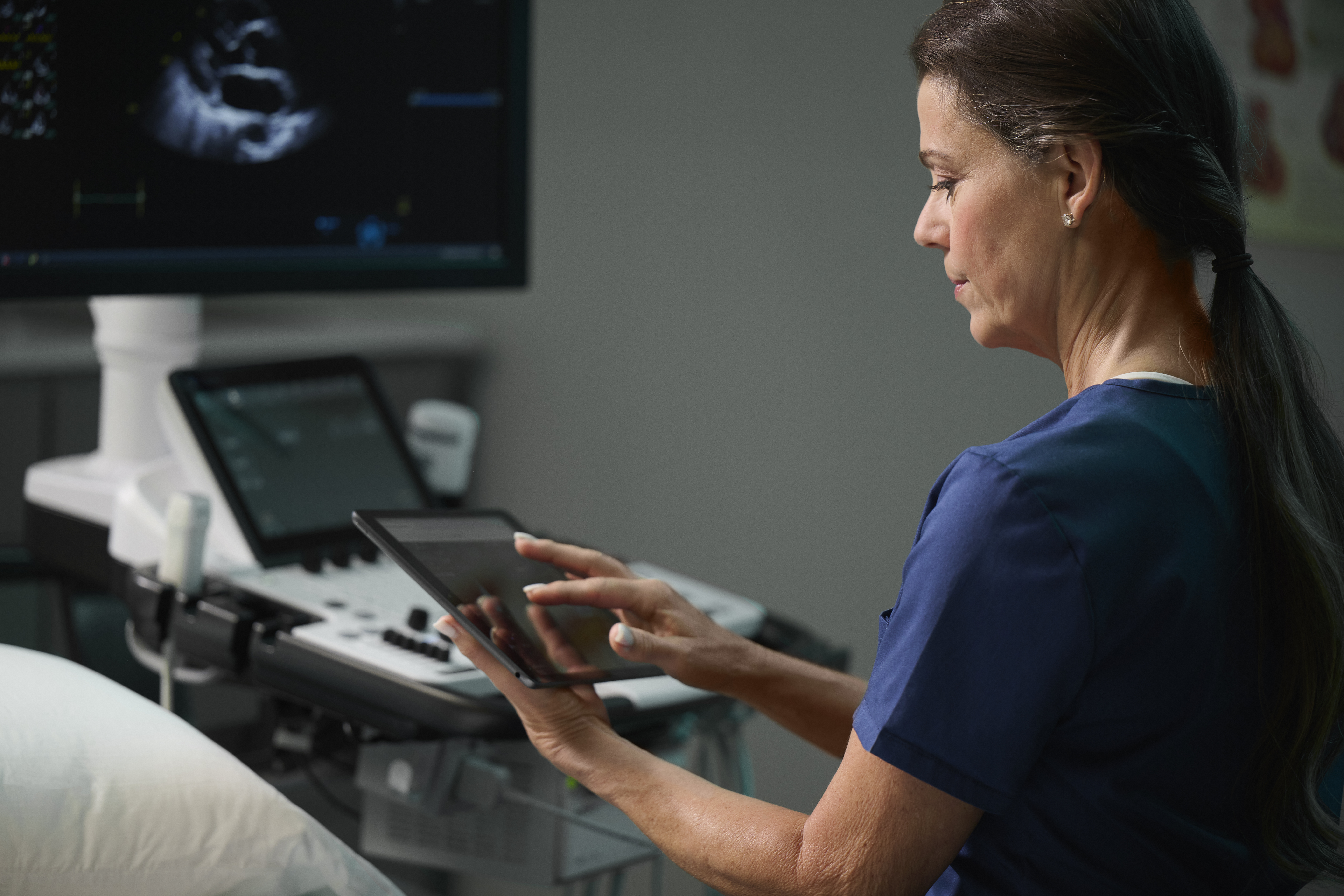
In cardiac ultrasound, precision is non-negotiable. Accurate acquisition, careful measurements, and complete documentation are essential. Cardiologists depend on consistent, high-quality data, and sonographers deliver it, exam after exam. As demand for echocardiography continues to grow, the challenge many teams face is how to sustain that precision at scale.
Preserving precision as echocardiography demand grows
Echocardiography is inherently time intensive. Even routine transthoracic exams require sonographers to capture dozens of views, perform extensive measurements, document findings across chambers and valves, and compile conclusions within the ultrasound scanning and reporting environment. For an experienced sonographer examining an echogenic, healthy patient, a comprehensive echocardiogram typically requires approximately 30 minutes of imaging and recording time.¹ That investment reflects the rigor cardiology depends on, and it does not compress easily.
As echocardiogram volumes rise the pressure shifts from individual exams to cumulative workload. Full schedules leave little margin for inefficiency, and small workflow frictions begin to matter more. Time spent navigating interfaces, entering data, and moving between screens is necessary, but it adds up. Over days and weeks, that cumulative effort can constrain throughput, extend reporting timelines, and place added strain on clinical teams.
Against this backdrop, finding opportunities for time savings in the workflow becomes less about speed and more about sustainability. The goal is not to reduce clinical rigor, but to ensure that precision can be maintained as volume increases and staffing pressures persist.
Cutting clicks and minutes per echo
ViewPoint EchoPilot™ is a cloud-based, AI-enabled solution that automates the measurement and reporting process for adult transthoracic echocardiograms. During a scan it identifies views, labels images, captures measurements, and generates a complete draft report in seconds, which clinicians can then quickly refine, rather than build from scratch.
In a controlled comparison study, cardiac sonographers were tasked with performing 18 routine adult TTE exams. Those that used ViewPoint EchoPilot showed consistent and measurable efficiency gains:
- Scanning time was cut nearly in half
- Exams and reporting were completed in 80 clicks, a 70% reduction in manual effort
- End-to-end exam time – including reporting – dropped to just about 8 minutes, a 46% reduction2
When applied to a private practice scenario with three clinicians performing eight exams per day, these reductions translate to approximately 54 minutes saved per day and more than 13 hours of time recovered each week across the team.2 While individual results may vary, the findings illustrate how reducing repetitive steps can help practices absorb growing demand without compromising exam integrity.
Reclaim your time with AI-powered echo reporting.
Less time building reports
While ViewPoint EchoPilot focuses on acquiring measurements and generating preliminary reports for routine echo exams to accelerate workflow in private practices, ViewPoint™ 6 addresses the effort required to complete the final report in busy clinical environment through its Auto Report Generation feature.
In an internal GE HealthCare study of eight cardiac sonographers’ workflow, use of ViewPoint 6 Auto Report Generation resulted in:
- 48% fewer clicks per report3
- Reduction in reporting time by up to 45%3
- 1 minute and 30 seconds saved per report on average4
Individually, these savings may appear incremental. Across a full clinical schedule, however, they become more meaningful. A cardiology department with five clinicians completing 10 exams per day could eliminate more than 1,600 clicks and over six hours of reporting time each week.5 Those reclaimed minutes can be redirected toward review, confirmation, and interpretation, areas where clinical expertise matters most.
Automation that supports clinical judgment
In cardiac ultrasound, automation is not intended to replace clinical judgment. Its role is to reduce repetitive manual tasks that do not contribute directly to diagnostic interpretation.
With tools such as ViewPoint EchoPilot and ViewPoint 6, sonographers and physicians retain full control. All findings are reviewed, edited, validated, and interpreted before final sign-off. Automation supports efficient report population and promotes consistency across users and sites. This helps to standardize workflows without constraining clinical decision-making.
Turning time into an advantage
In busy echo labs and private offices, small inefficiencies compound quickly. By reducing unnecessary clicks and manual steps, time-saving tools can help practices increase capacity without adding staff and support more timely physician review. Over time, that can translate into smoother clinic flow and more predictable days.
Reducing repetitive manual work may also help address sonographer fatigue and burnout, an ongoing concern as volumes rise and staffing remains tight. When automation takes on tasks such as populating measurements and preliminary findings, clinicians are better positioned to focus on interpretation, decision-making, and patient care.
ViewPoint EchoPilot and ViewPoint 6 are designed to support that balance. They help teams keep pace with demand while preserving the precision that cardiac ultrasound requires.
REFERENCES:
1. Bruce J. Kimura et al., “Time requirements of the standard echocardiogram: implications regarding limited studies,” Journal of the American Society of Echocardiography 16, no. 4 (2003): 1015 – 1018.
2. Based on a single internal, side-by-side comparison study performed by GE HealthCare. Three certified sonographers completed a routine adult transthoracic echocardiogram on the Vivid™ E95 system using two distinct workflows: a traditional manual and an automated workflow using ViewPoint EchoPilot. In the manual workflow, sonographers manually acquired images and performed measurements, followed by report generation in ViewPoint™ 6. No automation capabilities available on the scanner were utilized during this process to ensure a true baseline comparison. All final reports produced through the automated workflow still would require final clinical interpretation and validation by a qualified physician. Consistent number of images, measurements, and exam details across both workflows were performed. Live scanning was conducted on external scan subjects, including both male and female participants aged 45–60 years, with no significant health conditions. A total of 18 data sets were collected—9 per protocol—including both scan data and completed reports.
The average time saved for the end-to-end workflow by utilizing automated workflow with ViewPoint EchoPilot was 6 minutes 50 seconds per exam.
Assuming 8 exams performed by a clinician per day. Assuming a staff of 3 FTE employees each performing 8 exams a day.
Illustrative example. Actual results will vary based on patient’s case complexity, experience of a performing clinician and your institution’s circumstances. DOC3182533.
3. An internal, side-by-side comparison study was performed by GE HealthCare in August 2025. Eight Registered Diagnostic Cardiac Sonographer (RDCS) sonographers completed a routine adult transthoracic echocardiogram report using two different workflows: One workflow involved a traditional manual process with drop down clicks for all relevant findings and conclusions, and the other workflow involved an automated workflow using ViewPoint 6 Auto Report Generation. Consistent images, measurements, and exam details across both workflows were documented. While Auto Report Generation is able to automate many key findings (25 findings with version 6.15.4), it doesn’t automate all potential findings in a TTE Exam. Reports were generated from two adult echo exams stored on the ViewPoint 6 system. A total of 32 data sets were collected—16 per protocol.
4. The average time saved utilizing ViewPoint Auto Report Generation, compared to the manual process, was 1 minutes 30 seconds per report.
5. Assuming 10 exams performed by a clinician per day. Assuming a staff of 5 clinicians each performing 10 exams a day. illustrative example. Actual results will vary based on patient’s case complexity, experience of a performing clinician and the clinical circumstances.
ViewPoint and ViewPoint EchoPilot are trademarks of GE HealthCare.
Product and features may not be available in all countries and regions. Full product technical specification is available upon request. Contact a GE HealthCare representative for more information.
©2026 GE HealthCare. GE is a trademark of General Electric Company used under trademark license.
JB37131XX
