
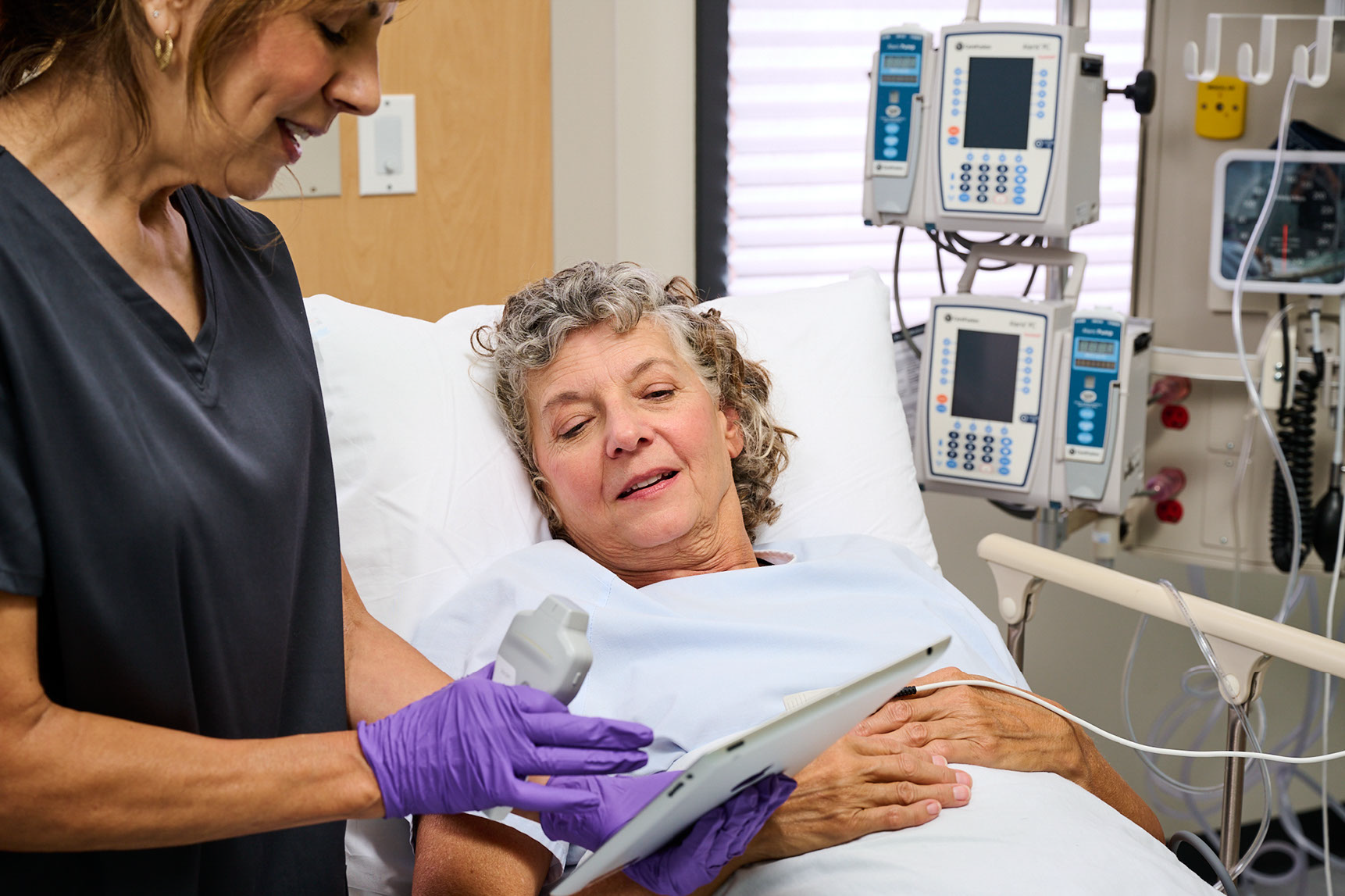
Efficiency took on new urgency in 2025, and Verisound™ Digital Ultrasound solutions played a central role in helping organizations adapt. By integrating AI-guided scanning, automated reporting, collaboration tools, fleet management and enterprise governance into daily workflows, ultrasound teams can experience meaningful reductions in manual effort and variability—gains that support clinicians already working under significant pressure.
What follows is a look back at how these capabilities shaped the year. Across acquisition, reporting, point-of-care expansion, and enterprise standardization, Verisound’s work demonstrated how efficiency can be scaled across entire ultrasound programs.
Efficiency and accuracy during ultrasound exams
Verisound automation and guidance tools are helping sonographers reclaim meaningful time amid growing exam volumes. ViewPoint™ 6 replaces paper worksheets and manual data entry with digital sonographer worksheets that enable fast and comprehensive reporting.
For cardiac sonographers, ViewPoint EchoPilot™ delivers even larger gains. By preparing measurements and draft reports automatically, it allows clinicians to focus on image acquisition. A transthoracic echocardiogram (TTE) that once required nearly 200 measurement clicks has been shown to drop to roughly 70—a 65% reduction—while cutting scanning time in half and allowing acquisition and measurements to be completed in under six minutes.1
Standardization also plays a crucial role in efficiency. With Verisound Fleet + Scan Assistant, lead sonographers can create scanning protocols and deploy them instantly across all connected systems. Any sonographer can walk up to any machine and perform a scan using the same, consistent workflow.
Collaboration and support can improve as well. Verisound Collab enables live remote collaboration* between sonographers, supervisors, and physicians, providing real-time system guidance even when senior staff are off-site. At the bedside, Caption Guidance™, available on Vscan Air™ SL and Venue™ systems, provides AI-driven prompts to help clinicians of all experience levels capture high-quality images with greater ease.
Together, these capabilities can help sonographers reclaim time per exam—time often lost to labeling, re-measuring, and navigating multiple interfaces. As workforce pressures persist, these efficiencies can contribute to reduced fatigue, improved onboarding, and more sustainable workloads.
Dive deeper
- Sonographer shortage solutions: 4 ways to strengthen ultrasound department efficiency
- Echocardiography AI: Reducing clicks, fatigue, and burnout for sonographers
- AI-Guided Ultrasound: From Innovation to Impact
- Gaining efficiency in ultrasound: Is AI the only way?
Helping clinicians move faster from image to insight
While exam acquisition is one source of workflow pressure, reporting has become an equally significant bottleneck. As documentation requirements grow, many radiologists and cardiologists are spending more time navigating software than interpreting images. Verisound tools have a relentless focus on supporting these providers.
For radiologists, ViewPoint™ 6 supports faster, more consistent reporting through structured templates, automated measurement transfer, and customizable layouts that reduce clicks and support timely, accurate documentation.
Cardiology teams face similar pressures, particularly given the measurement-intensive nature of echocardiography. ViewPoint 6 powered by EchoPAC™ brings advanced quantification and post-processing to the desktop, enabling clinicians to review studies quickly—whether in the hospital, at a satellite clinic, or working remotely—while keeping ultrasound systems available for scanning.
ViewPoint EchoPilot™ introduces another level of efficiency. Workflow evaluations show reporting steps dropping from 73 clicks to as few as 10 by allowing clinicians to refine AI-generated findings rather than build a report from scratch.1 End-to-end workflow time decreased from 15 minutes and 270 clicks to under nine minutes and roughly 80 clicks—a 70 percent reduction in manual effort.1 For a three-cardiologist practice, this could return up to 13 hours each week.1
Looking ahead, clinicians are expressing growing interest in generative AI to further support reporting accuracy and consistency. While not part of commercially Verisound products today, early exploration highlights clear priorities: quality assurance, standardized language, and assistance with first-draft reporting. These insights are guiding Verisound development opportunities.
Dive deeper
- Fewer clicks, more clarity: Enhancing cardiovascular ultrasound reporting & analysis
- Ultrasound, unburdened: The path to radiologist efficiency
- Scaling echocardiography in private practice with AI
- Verisound delivers on radiologists’ imaging IT wish list
- Gen AI in ultrasound reporting: Radiologists rank potential use cases
- Gen AI in ultrasound reporting: Standardization and efficiency take center stage
Supporting the rise of point-of-care ultrasound
Point-of-care ultrasound (POCUS) continued expanding across emergency medicine, primary care, and hospital medicine. As adoption grows, clinicians need workflows that keep pace with bedside decisions while ensuring documentation remains complete and compliant.
Verisound’s POCUS capabilities can help standardize templates, simplify documentation, and connect every exam to the enterprise imaging ecosystem—reducing variability and supporting continuity of care. In high-acuity environments, these tools can support communication across care teams, allowing POCUS to function not just as a rapid diagnostic tool but as a reliable, integrated part of the imaging workflow.
Dive deeper
- Innovations in POCUS workflow: Notes from HIMSS25
- Closing the gaps in emergency ultrasound reporting and reimbursement
When ultrasound scales, governance becomes the new efficiency engine
As ultrasound programs expand across service lines, campuses, and care settings, biomedical and healthcare technology management teams are being asked to support a growing and increasingly distributed device fleet. Verisound helps bring order to that complexity by providing centralized visibility and control over ultrasound systems across the enterprise. With digital governance tools designed to support IT and biomed workflows, teams can manage configurations and maintain consistent protocols without relying on manual, site-by-site processes. The result is a more efficient way to keep systems current and aligned, even as device counts and clinical use cases continue to grow.
Dive deeper
- Verisound case study: How SLUHN standardized ultrasound across its enterprise
- Ultrasound biomedical engineering: Going digital to reduce windshield time
- From 15 Hours to 7 minutes: Do the math on your ultrasound protocols
- Ultrasound software subscription: A smarter way to stay current
- 6 tips for talking to IT about digital ultrasound solutions
Efficiency will define the next era of ultrasound
2025 demonstrated that efficiency is now essential to sustainable ultrasound practice. In 2026, Verisound will continue supporting organizations as they build faster, more consistent, and more resilient workflows.
REFERENCES:
1.) Based on a single internal, side-by-side comparison study performed by GE HealthCare. Three certified sonographers completed a routine adult transthoracic echocardiogram on the Vivid™ E95 system using two distinct workflows: a traditional manual and an automated workflow using ViewPoint EchoPilot. In the manual workflow, sonographers manually acquired images and performed measurements, followed by report generation in ViewPoint™ 6. No automation capabilities available on the scanner were utilized during this process to ensure a true baseline comparison. All final reports produced through the automated workflow still would require final clinical interpretation and validation by a qualified physician. Consistent number of images, measurements, and exam details across both workflows were performed. Live scanning was conducted on external scan subjects, including both male and female participants aged 45–60 years, with no significant health conditions. A total of 18 data sets were collected—9 per protocol—including both scan data and completed reports.
The average time saved for the end-to-end workflow by utilizing automated workflow with ViewPoint EchoPilot was 6 minutes 50 seconds per exam.
Assuming 8 exams performed by a clinician per day. Assuming a staff of 3 FTE employees each performing 8 exams a day.
Illustrative example. Actual results will vary based on patient’s case complexity, experience of a performing clinician and your institution’s circumstances. DOC3182533.
*Not for diagnostic use
Verisound, ViewPoint, and Vscan Air are trademarks of GE HealthCare.
Product and features may not be available in all countries and regions. Full product technical specification is available upon request. Contact a GE HealthCare representative for more information.
JB36522XX
